
Blogs > Promotion Guardrails: Key to Managing Regulatory and Commercial Risks for Promotional Planning
Promotion Guardrails: Key to Managing Regulatory and Commercial Risks for Promotional Planning
Fri May 22 2026

Author
Noah Xiao
Promotions look simple from the outside. Stick a product on sale, customers buy more, everyone wins.
Anyone who has actually planned a promotional calendar knows the truth is a bit messier.
Behind every "20% off this week" sits a quiet pile of questions. Is the discount deep enough to shift volume, but not so deep that we destroy the margin? Have we promoted this product too often this quarter? Is the reference price we are comparing against actually real? Is the funding enough of the markdown? Are we accidentally clashing with a competing brand in the same category? And, increasingly important, are we on the right side of the regulators if someone asks?
Get those questions right and promotions become a powerful growth lever. Get them wrong and the costs add up fast, eroded margin, frustrated suppliers, confused shoppers, and in some cases, a please-explain from a regulator like ACCC.
The retailers and suppliers we work with at jahan.ai live with these questions every day. Almost all of them, regardless of size or category, eventually land on the same conclusion: good promotional planning requires clever strategy, but it must be grounded in rigorous discipline.
That discipline has a name. It's called promotion guardrails.
What Are Promotion Guardrails?
If promotion planning is the strategy, guardrails are the lane markers that keep that strategy on the road.
A promotion guardrail is a rule. A boundary. Something that says, "yes, you can promote this product, but not deeper than X, not more often than Y, not in combination with Z, and never in a way that breaches A."
Guardrails are not there to make planning harder. They are there to make planning safer and more coherent to the business strategy, by removing the kinds of decisions nobody should be making manually every week.
In a healthy promotional process, guardrails do four jobs at once:
- They protect margin from being quietly bled away by deep or frequent discounting
- They protect brands from being trained into "always on sale" behaviour
- They protect the business from regulatory and reputational risk
- They protect relationships between commercial teams, between retailers and suppliers, and between the business and its customers
Done well, guardrails are invisible. They sit in the background, quietly stopping bad promotions before they get planned, while letting the good ones through.
Why Guardrails Matter More Than Ever
Shoppers have been conditioned to wait for a deal. Cost-of-goods volatility has squeezed margin from the supply side. Competitive intensity means promotional calendars are tighter and busier than ever. And the regulatory environment around pricing, reference prices, and promotional claims has tightened across most major markets, including Australia.
Without guardrails, that combination is genuinely dangerous. A planner under pressure to hit a number can, with the best intentions, sign off on a plan that:
- Drives short-term sales but destroys category profitability
- Looks compliant but technically misuses a reference price
- Funds a deep discount the supplier never actually agreed to underwrite
- Repeats a promotion so often the product effectively has no "real" price anymore
- Clashes with another promo and cannibalises both
These are not theoretical risks. They are the kinds of issues we see surface in audits, supplier reviews, and category post-mortems all the time, precisely because clients struggled to manually maintain and configure these rules across the enormous combinations of products and stores in their planning scope.
The Guardrails Retailers and Suppliers Usually Care About
When we sit down with retail and supplier teams to talk about guardrails, the conversation almost never starts with algorithms. It starts with the very real, very specific rules they already use (or wish they used) to keep their promotional plans sensible.
These rules tend to cluster into five themes. None of them are exotic. All of them matter.
1. Regulatory and Legal Guardrails — the Must Do Rules
These are the non-negotiables. The rules driven by law, regulator guidance, or category restrictions.
Common examples we see in market:
- No "fake" discounts.A promo price can't be equal to or higher than the recent regular selling price. Sounds obvious,easy to miss when prices have changed twice in the last month, e.g. RRP is $10, buy one is $5 at a discount, and buy two becomes $12, this is what is uncommon to see even in the biggest national retailers.
- Genuine reference pricing.If a product is advertised as "was $20, now $8", the $20 needs to be a real, recently-charged price. Advertised savings over a certain threshold (often around 60%) are a red flag that the reference price isn't genuine.
- Margin Normalisation.When wholesale costs or supply chain issues resolve after a temporary spike, retail prices must be reviewed and adjusted accordingly. The business needs a way to flag out the impacted product to ensure it isn't artificially maintaining crisis-level pricing, which protects the brand from customer backlash and accusations of price gouging.
- Establishment periods.A product can't sit on promotion for so long that it never has an established regular price. In practice, this often shows up as a cap on consecutive promotional weeks.
- Category restrictions.Tobacco promotions are prohibited in most jurisdictions. Alcohol bulk-buy incentives above a certain quantity can breach responsible service requirements. Some categories have their own specific rules.
- Cross-Channel Consistency.Customers expect a seamless experience. An item's promotional price online should perfectly match the price on the shelf in-store, unless the business is running a deliberate "online-only" exclusive.
- New product promotions.Promoting a product before it has actually launched, or before it has had any real selling history at full price, creates compliance risk.
Most retailers already have these rules written down somewhere. The challenge isn't knowing them. It's making sure every single promotion across hundreds of thousands of SKUs actually respects them, all the time.
2. Margin and Pricing Guardrails — the Commercial Boundary
These are the rules that protect the P&L.
Examples that come up in nearly every conversation:
- Maximum discount depth."We don't go deeper than 50% off without category director sign-off."
- Minimum margin floors."Promoted price must keep us above X% gross margin."
- No promo below cost. Unless there is an explicit loss-leader strategy with funding behind it.
- Price ladder protection.A premium SKU shouldn't end up cheaper than the mid-tier alternative just because it's on promo this week.
- Cross-channel consistency.Online and in-store promo prices should match unless there's a deliberate reason they shouldn't.
- Charm pricing rules.Promotional prices stick to the retailer's pricing conventions ($X.99, $X.95, and so on) rather than landing on awkward numbers.
These rules quietly do a huge amount of work. They are also the rules most likely to be broken by manual planning under time pressure.
3. Frequency and Fatigue Guardrails — Protecting the Brand
This is where retailers and suppliers often disagree, and where good guardrails make the conversation easier.
Common examples:
- Maximum promotional frequency."No SKU on deal more than 12 times a year." Or "no more than 25% of weeks on promotion."
- Minimum gap between promos."At least four weeks between promotional events on the same product."
- Maximum promotional duration."No promo runs for more than eight consecutive weeks." Beyond that, customers stop treating it as a discount and start treating it as the new normal price.
- Promotional cycle structure.Weekly, monthly, quarterly, or event-based promo windows that align with the retailer's broader calendar.
- Lead time and cooldown for events.Christmas, Easter, EOFY and back-to-school all need extra space around them.
Suppliers care deeply about frequency rules because they protect long-term brand equity. Retailers care because they protect the integrity of "sale" as a customer signal.
4. Clash, Cannibalisation, and Category Guardrails — Avoiding Self-Inflicted Wounds
Typical rules in this space:
- No two competing brands on deal in the same weekwithin the same sub-category.
- No more than one product per pricing group on promotion at a time.
- Consistent promo treatment for items in the same pricing group. They move together, or not at all.
- Cross-category considerationfor products where promoting one cannibalises another (think yoghurt versus dairy desserts).
- Bundle and adjacency rules. Some products are meant to be promoted together (steak and red wine, sunscreen and sunglasses), and some are meant to be kept apart.
Getting these right is the difference between a category-led promotional plan and a SKU-by-SKU plan that quietly competes with itself.
5. Funding, Supply, and Execution Guardrails — Keeping Promotions Real
A promotion is not just a price decision. It is a commercial agreement and an operational commitment.
Real-world examples:
- Minimum supplier funding contribution."Supplier must fund at least 50% of the markdown for the promo to go ahead."
- Approved funding mechanics only.Scan-down, off-invoice, or lump sum, whatever the trading agreement says.
- Minimum trade spend ROI.A promotion that doesn't return the investment doesn't get scheduled.
- Premium placement requires premium support.Ends, front page catalogue spots and islands typically require lump-sum funding rather than just per-unit support.
- Supply chain feasibility.No promoting a product the DC can't actually fulfil through peak.
- Catalogue and in-store capacity.Front page caps, end-cap limits, point-of-sale slots, and aisle placement rules that reflect what the store can physically handle.
These are the guardrails that turn a promotional plan from a spreadsheet into something the operation can actually execute on Monday morning.
Most retailers and suppliers already have a version of these rules. They might live in a planning policy document, a category playbook spreadsheet, a trading agreement, or just in the head of the most experienced planner on the team.
The hard part isn't writing them down. The hard part is applying them, consistently, across thousands of SKUs and hundreds of promotional decisions, every single week, without slowing the business down.
That's the gap that good technology is built to close.
How jahanVerse Helps Bring This Together
Once you accept that good promotional planning needs hundreds of guardrails working together in the background, you start to see why this is hard to do well in spreadsheets, or even in most traditional planning tools.
At jahan.ai, our unified retail and supply chain planning platform, jahanVerse, was built with this exact problem in mind. A few things worth calling out.
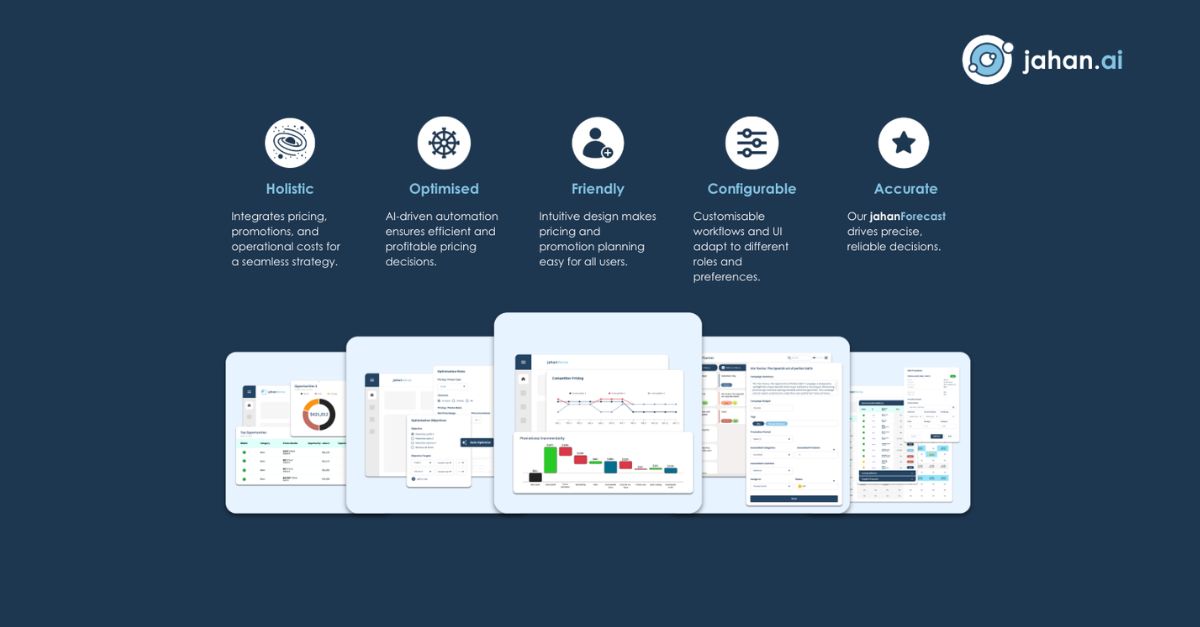
jahanVerse - Promotion Planner
Comprehensive Coverage of All Critical Guardrails
jahanVerse supports a comprehensive list of guardrails across key categories, including the ones mentioned above, e.g. Regulatory and Legal, Margin and Pricing, Frequency and Fatigue, Clash and Cannibalisation, and Funding, Supply, and Execution Guardrails, and these standard rules are tailored during platform implementation. Furthermore, planner users can define their own custom guardrails using the Rules Engine easily too.
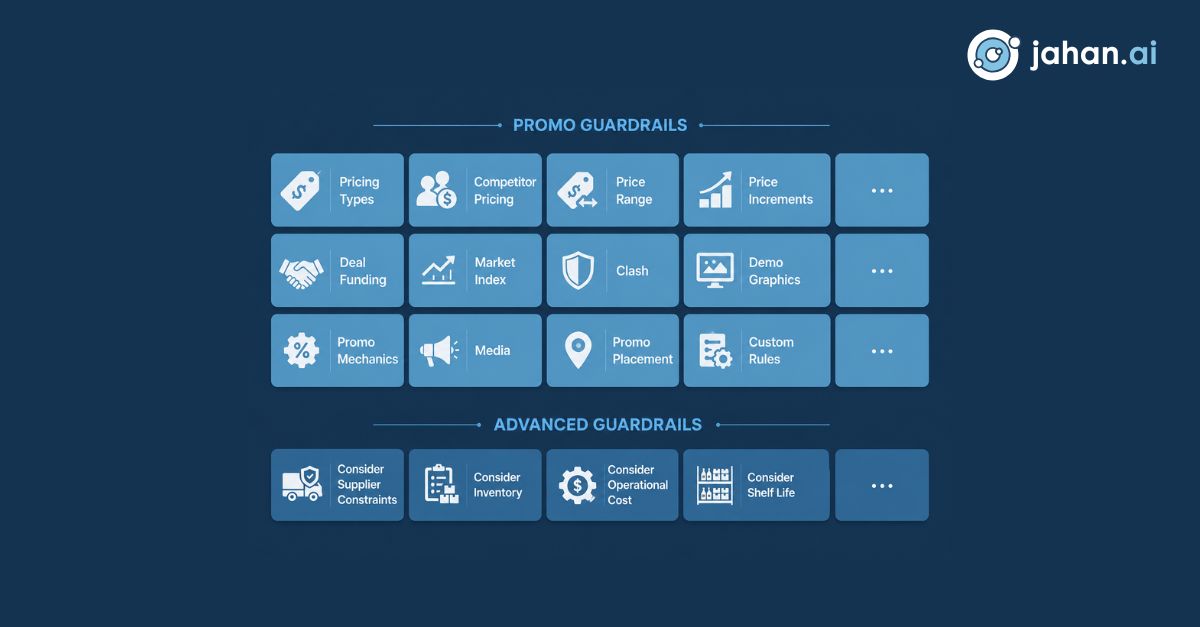
Example Guardrails
Guardrails Live Inside the Planning Workflow
Guardrails in jahanVerse aren't a separate compliance dashboard you check at the end. They sit directly inside the Promotion Optimisation workflow, alongside the objective, scope, and algorithm settings.
That means when a planner kicks off an optimisation run, the system is already considering every regulatory rule, margin floor, frequency cap, clash rule, funding requirement, and placement constraint. The optimiser doesn't search the universe of possible plans, it searches the universe of acceptable plans.
The result is recommendations that don't need to be unpicked and reworked before they can go live.
Guardrails as Proactive Validation and Flagging
The Guardrails module goes beyond defining the automatic promotion plans; it acts as a validation engine for any plan, whether manually created, imported, or tweaked. This catches issues before a plan is finalised.
If a plan breaches a guardrail, the system immediately flags the non-compliant item and scope with a warning, provides an explanation about why it is non-compliant, and offers specific recommendations on how to achieve compliance, such as resolving conflicting promotions. This ensures compliance is maintained across all planning methods.
For planners, that means:
- Knowing exactly which rule was breached and why
- Understanding the commercial or regulatory implication in plain language
- Getting an actionable suggestion (for example, "reduce discount to 15% to stay within the margin floor") rather than a vague warning
- Re-running scenarios in minutes, not days
A Custom Rules Engine for the Rules That Are Yours
Every retailer and supplier has rules that are uniquely theirs. Sometimes they reflect category strategy. Sometimes they reflect supplier agreements. Sometimes they reflect lessons learned the hard way.
jahanVerse includes a visual, no-code Rules Engine that lets commercial teams build and maintain those rules without needing to ask developers for help. Things like seasonal product handling, replenishment rules, protecting SKUs based on the past ROIs, dynamic margin floors, and range cap constraints can be defined, tested and adjusted by the people who actually own them.
It turns guardrails from a static document into a living part of how the business runs.
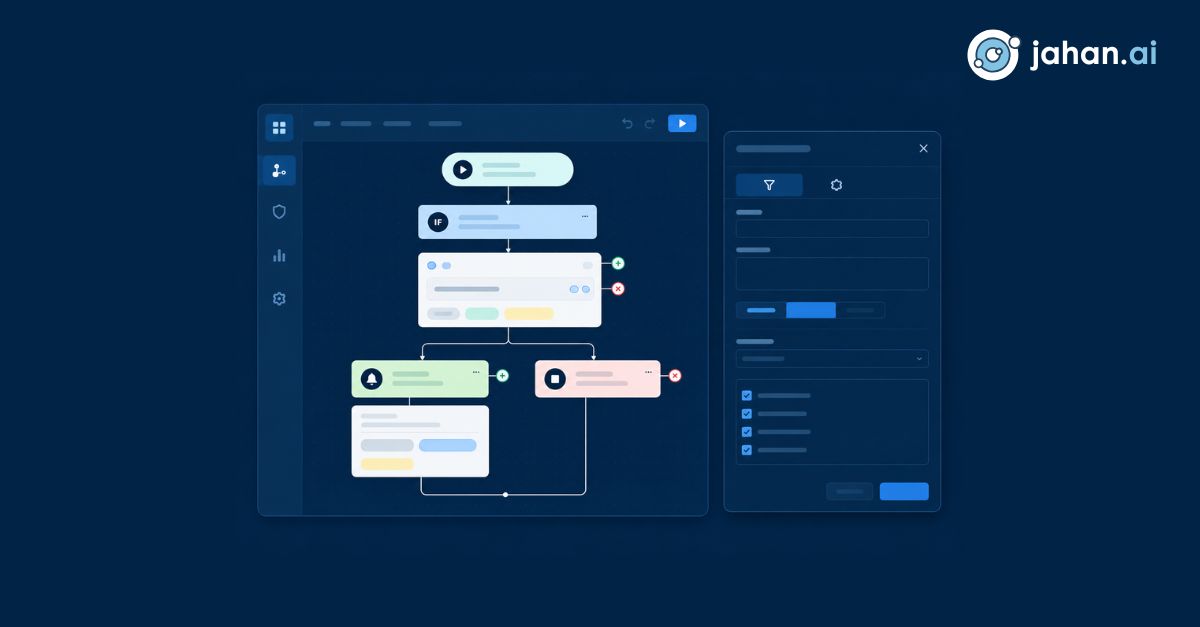
Custom Guardrail Rule Builder
Forecasting That Makes the Trade-Offs Real
Guardrails define what is allowed. jahanForecast, our machine learning demand engine, helps you understand what is likely to happen within those boundaries.
That combination matters. A guardrail tells you a 50% discount is the maximum allowed. A good forecast tells you a 30% discount is the smartest within that range, because the incremental lift above 30% doesn't justify the margin hit.
This is where guardrails and optimisation stop being separate ideas and start working together.
Scenario Modelling for the Bigger Strategic Questions
Sometimes the real question isn't "is this promo plan compliant?", it's "what if we changed the rules?"
jahanVerse lets teams run side-by-side scenarios with different guardrail settings. What happens to profit if we cap discount depth at 40% instead of 50%? What does the calendar look like if we tighten frequency rules across home brands? How does category performance change if we require minimum 60% supplier funding on all top-tier promotions?
These are strategic conversations, not just planning tasks. Having the data to back them up changes how commercial decisions get made.
Outlook
Promotional planning is not going to get simpler. Margins will stay tight. Shoppers will keep expecting value. Regulators will keep paying attention. Suppliers and retailers will keep needing better ways to work together.
The businesses we see thriving in this environment aren't the ones promoting the most. They are the ones promoting the most deliberately, with clear objectives, clear guardrails, and tools that let them act on both without slowing the business down.
Promotion guardrails are how that deliberate approach gets built into the day-to-day. They turn promotional planning from a high-stakes guessing game into a controlled, repeatable, improvable process.
Why Partner with jahan.ai
Partnering with jahan.ai means collaborating with a team that has extensive experience and a laser focus on your measurable return-on-investment. Our team is composed of top-tier supply chain business experts, data scientists, and engineers, alongside dedicated engagement and change experts who speak your language and think in your shoes.
We combine deep retail, supply chain, and manufacturing expertise with cutting-edge AI to deliver real, measurable value. Our platform, jahanVerse, is proven to deliver significant margin uplift and productivity gain, with clients consistently achieving:
- An average of 9.5% margin uplift per annum with better promotion performance.
- ~150 hours saved from quarterly planning per head.
- 100% guardrail compliance with less back-and-forth.
If you are thinking about how your team handles promotional risk, whether that's margin, frequency, funding, compliance, or all of the above, we'd genuinely enjoy the conversation. No pitch deck required.
Drop us a line at info@jahan.ai. We're always keen to share what we've seen across the industry and help where we can.
#guardrails
#jahanPricingAndPromo
#promotion